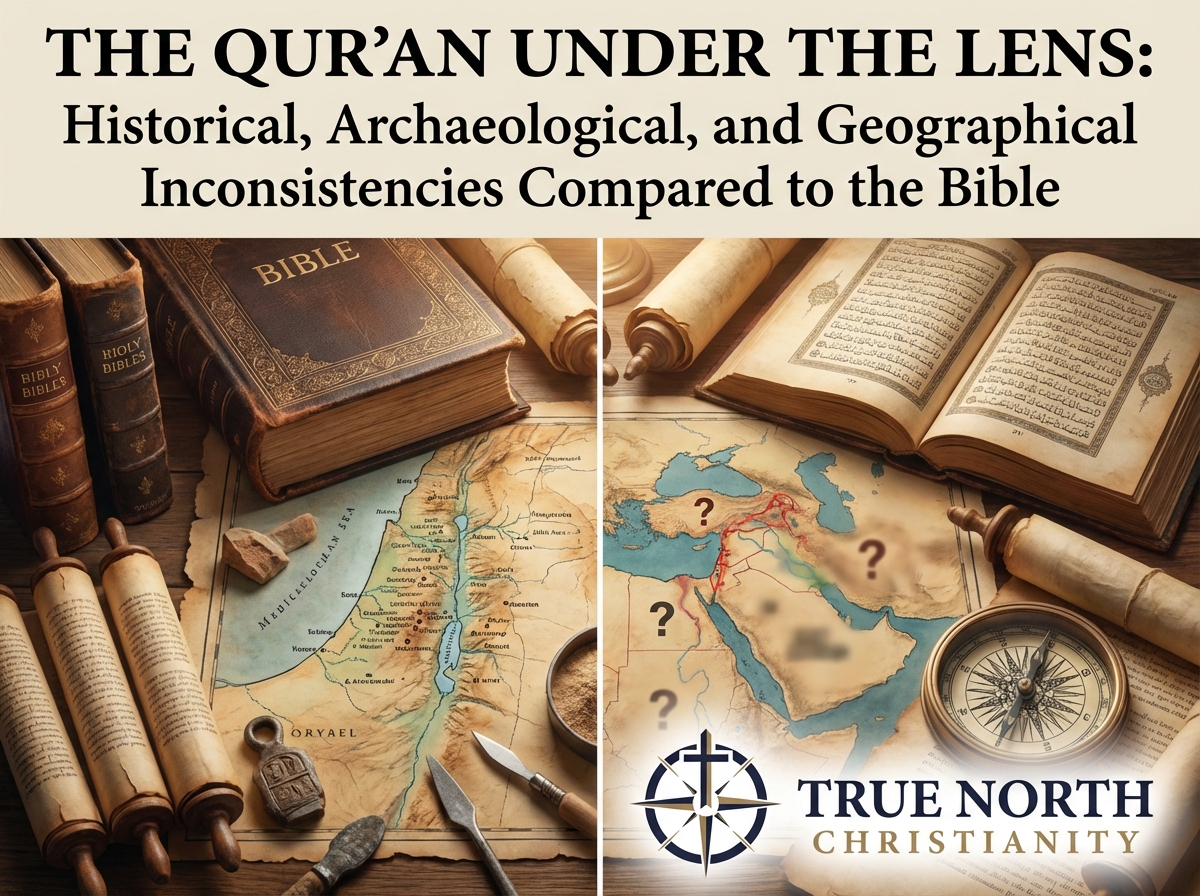
The Qur’an Under the Lens: Historical, Archaeological, and Geographical Inconsistencies Compared to the Bible
Islam presents the Qur’an as the final, perfect, and uncorrupted revelation of God—eternally preserved, historically flawless, and superior to all prior scriptures. This claim places the Qur’an in a unique position: if it contains historical, archaeological, or geographical errors, its foundational claim collapses.
By contrast, the Bible does not ask to be believed blindly. It invites investigation. Again and again, biblical places, people, and events have been confirmed—sometimes centuries later—by archaeology, geography, and external historical sources.
When both texts are examined under the same objective lens, a stark difference emerges.
1. The Qur’an’s Historical Dependence on Later Traditions
One of the most striking features of the Qur’an is that many of its biblical narratives diverge sharply from known Jewish and Christian sources—yet closely resemble later apocryphal legends, not the original texts.
Example: Mary, the Mother of Jesus
The Qur’an identifies Mary (Maryam), the mother of Jesus, as the sister of Aaron (Qur’an 19:28), a figure who lived roughly 1,400 years earlier during the time of Moses.
Islamic scholars often argue this is symbolic language, yet:
- The Qur’an consistently presents biblical figures as literal historical people
- No such symbolic usage exists in Jewish or Christian Scripture
- The explanation only appears after the error is noticed
The Bible, by contrast, clearly distinguishes:
- Miriam, sister of Moses (Exodus)
- Mary, mother of Jesus (Gospels)
This is not a minor detail—it is a chronological impossibility.
2. Pharaohs, Kings, and Egypt: A Major Historical Error
The Qur’an repeatedly refers to the ruler of Egypt during the time of Joseph as “Pharaoh”.
Modern Egyptology has demonstrated conclusively:
- The title Pharaoh was not used during Joseph’s era
- The term only became standard centuries later, during Moses’ time
The Bible is precise:
- Joseph serves under a ruler not called Pharaoh (Genesis 41)
- Moses confronts a ruler explicitly titled Pharaoh (Exodus)
This distinction was unknown until modern archaeology, yet the Bible preserves it accurately—while the Qur’an collapses the timelines.
3. The Qur’an’s Geography Problem
Mecca: A City Without a Past
Islam claims Mecca was:
- A major trade hub
- The center of Abrahamic worship
- Known throughout the ancient world
Yet:
- No Greek, Roman, Persian, or Jewish source mentions Mecca
- No inscriptions, coins, or trade records reference it before the 7th century
- Trade routes bypass the city entirely
By contrast, biblical cities such as:
- Jerusalem
- Jericho
- Nineveh
- Babylon
- Damascus
…are repeatedly confirmed by archaeology and external records.
A city cannot be the spiritual and commercial heart of the ancient world and leave zero historical footprint.
4. Abraham’s Journey: A Geographical Impossibility
The Qur’an places Abraham and Ishmael in Mecca, building the Kaaba.
The Bible states:
- Abraham lived in Mesopotamia, Canaan, and Egypt
- His movements are geographically coherent and traceable
- Every location mentioned exists, fits known travel routes, and matches archaeology
There is no evidence—biblical, archaeological, or historical—that Abraham ever traveled 1,200 miles south into Arabia, crossing deserts unknown to ancient patriarchs.
This raises a critical question:
Why does Abraham appear everywhere archaeology confirms—except where the Qur’an places him?
5. The Kaaba and Pre-Islamic Paganism
Islam teaches the Kaaba was originally built by Abraham for monotheistic worship.
However:
- Pre-Islamic Arabia was deeply polytheistic
- The Kaaba housed 360 pagan idols
- Islamic sources themselves confirm this
There is no evidence of:
- Jewish worship
- Abrahamic monotheism
- Mosaic law
- Temple-style sacrifices
…in Mecca prior to Muhammad.
By contrast, the Bible’s temple system, priesthood, sacrifices, and festivals are archaeologically and historically grounded.
6. Jesus: Theology Without History
The Qur’an claims:
- Jesus was not crucified
- Someone else was substituted in His place
Yet:
- Roman historians (Tacitus)
- Jewish sources (Josephus)
- Early Christian writings
- Archaeological context
…all confirm the crucifixion as a historical event.
The crucifixion is one of the best-attested events in ancient history.
The Qur’an does not provide:
- A witness
- A historical source
- A timeline
- A mechanism
It simply asserts denial—600 years later.
The Bible presents:
- Named rulers
- Known locations
- Recorded trials
- Roman execution methods
History aligns with the Bible—not the Qur’an.
7. Preservation Claims vs. Textual Reality
Islam claims the Qur’an has been perfectly preserved.
Yet Islamic sources admit:
- Verses were lost
- Different companions recited different versions
- Caliph Uthman burned competing manuscripts
- Early Qur’ans show textual variation
By contrast:
- The Bible has thousands of manuscripts
- Variants are documented openly
- No central authority erased competing texts
- Archaeological discoveries (Dead Sea Scrolls) confirm remarkable consistency
The Bible withstands transparency.
The Qur’an requires control.
8. The Pattern Is Clear
When examined objectively:
| Area | Bible | Qur’an |
|---|---|---|
| Archaeology | Repeatedly confirmed | Largely absent |
| Geography | Precise and consistent | Often vague or incorrect |
| Chronology | Internally coherent | Frequently collapsed |
| External sources | Widely supported | Mostly absent |
| Historical method | Grounded in witnesses | Based on assertion |
This is not coincidence.
Conclusion: Truth Does Not Fear Examination
The Bible presents a faith rooted in real places, real people, real events, and real consequences. Its claims can be tested—and again and again, they hold.
The Qur’an demands belief first—and explanation later.
This does not mean Muslims are dishonest or unintelligent. It means the text itself cannot bear the weight of its own claims when exposed to history, archaeology, and geography.
Truth does not need to revise timelines.
Truth does not need to borrow legends.
Truth does not erase evidence.
Truth stands.
And when examined honestly, the historical record points not toward Mecca—but toward Jerusalem.